|
STRUCTURAL STEELWORK SPECIFICATION / SPECIFIER RESOURCE PACK
Blind Steel Connections: The Technical Guide to Specifying Lindapter Hollo-Bolts
Connecting structural steel sections is a fundamental challenge in modern commercial construction, especially when dealing with Structural Hollow Sections (SHS, RHS, or CHS). Because you only have access to one side of the steel tube, traditional standard bolting is out of the question—leaving structural engineers and site managers with a historic dilemma: deal with the massive overhead of on-site welding, or switch to a dedicated blind fixing. While welding has long been considered the default fallback, Lindapter Hollo-Bolts have completely changed the economics and speed of blind steel connections.
|
THE HOLLO-BOLT MECHANISM
The Hollo-Bolt is a highly engineered expansion cavity fixing inserted into pre-drilled clearance holes. As the main bolt head is tightened to its structural torque specification, the internal cone forces its split sleeve components outward, forming a rock-solid mechanical clamp against the inside wall of the hollow section.
|
VISUAL FIELD GUIDE: HOLLO-BOLT SPECIFICATION OPTIONS
Review the engineering design profiles below to determine the ideal blind mounting configuration for your site criteria. Click directly on each placeholder image below to link your required configuration or drop in your product drawings.
|
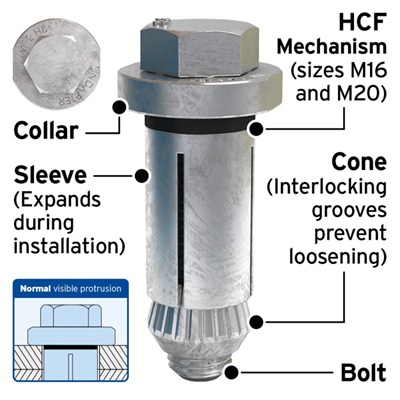
Hex Head: Component Breakdown
Engineering breakdown of the inner design components, high-tensile core bolt, internal expansion cone, and sleeve parts of the standard Hex Head model.
|
|
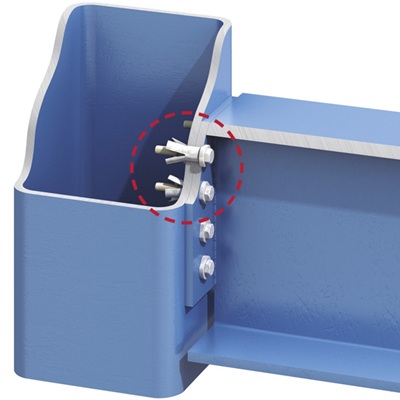
Hex Head: Section Application
Cutaway profile demonstrating the structural anchor mechanism expanded tightly against the internal metal wall face of a hollow framework cavity.
|
|
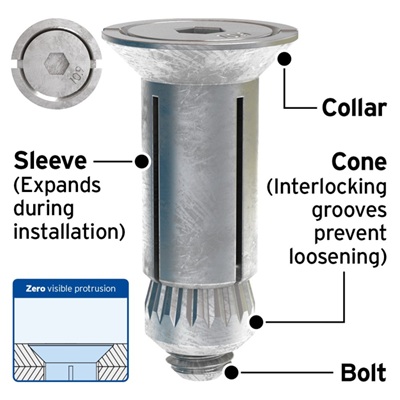
Flush Fit: Component Breakdown
Component layout configuration of the specialised countersunk head alternative, engineered specifically to support clean flush tracking.
|
|
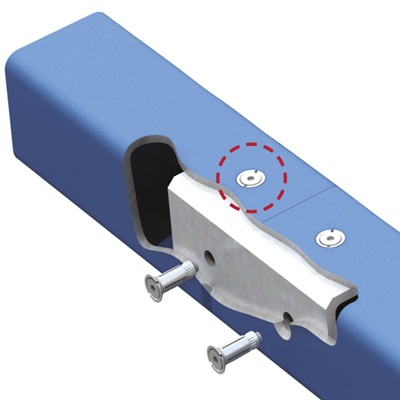
Flush Fit: Section Application
Application render demonstrating a completely flat, obstruction-free outer steel plate surface finish ideal for glazing or cladding tracks.
|
PERFORMANCE MATRIX: HOLLO-BOLTS VS. ON-SITE WELDING
Review how cold mechanical steel anchors compare against traditional on-site structural welding across vital commercial project parameters:
| Feature / Factor |
On-Site Structural Welding |
Lindapter Hollo-Bolt |
| Installation Speed |
Slow (Setup, preparation, weld lines, cooling, cleaning) |
Fast (Installs into pre-drilled holes in minutes) |
| Labour Needs |
Highly paid, certified structural class welders |
Standard site erectors equipped with basic hand tools |
| Site Safety |
Extreme risk (Hot work permit logs, safety screens, flash arcs) |
Zero risk (Completely cold mechanical configuration) |
| Quality Assurance |
Non-destructive testing (NDT) / Costly Ultrasonic sign-off |
Simple visual parameter inspection of calibrated torque |
| Corrosion Protection |
Vapourises finish; requires site coating patch re-painting |
Available factory Hot Dipped Galvanised (HDG) or Stainless |
CORE OPERATIONAL ADVANTAGES
- Zero Structural Coating Degradation: Because Hollo-Bolts are a cold mechanical connection, the integrity of your factory-applied protective primer coatings or hot-dipped galvanisation remains completely uncompromised.
- Immediate Structural Load Bearing: The moment a Lindapter Hollo-Bolt is torqued down to specification using standard calibrated site equipment, it achieves its full catalogued tensile and shear load capacities immediately.
- Fully Approved, Predictable Capacities: Lindapter Hollo-Bolts come with full CE/UKCA marking and extensive structural load data charts approved by international engineering bodies, eliminating weld-testing guesswork.
|